
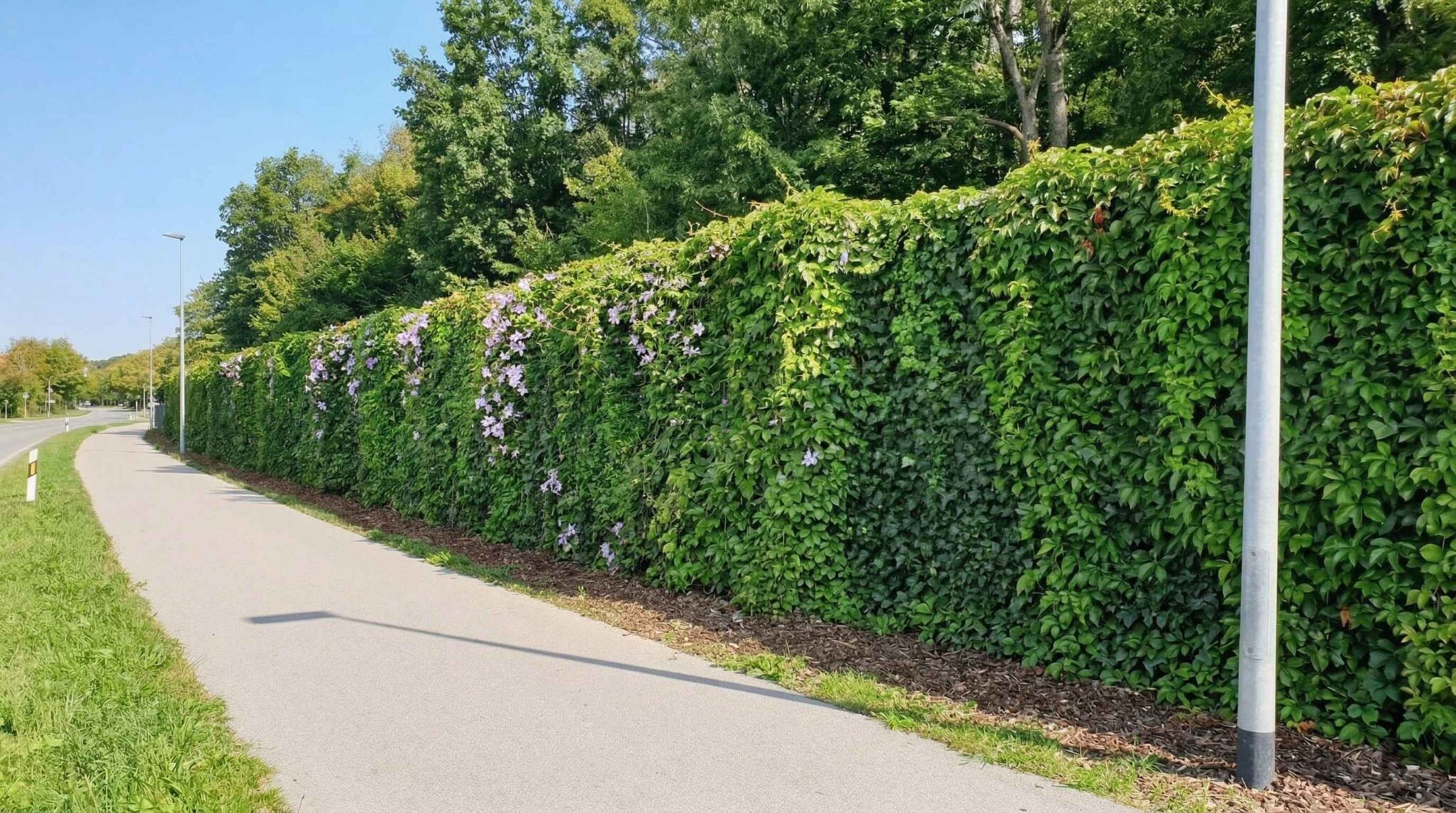
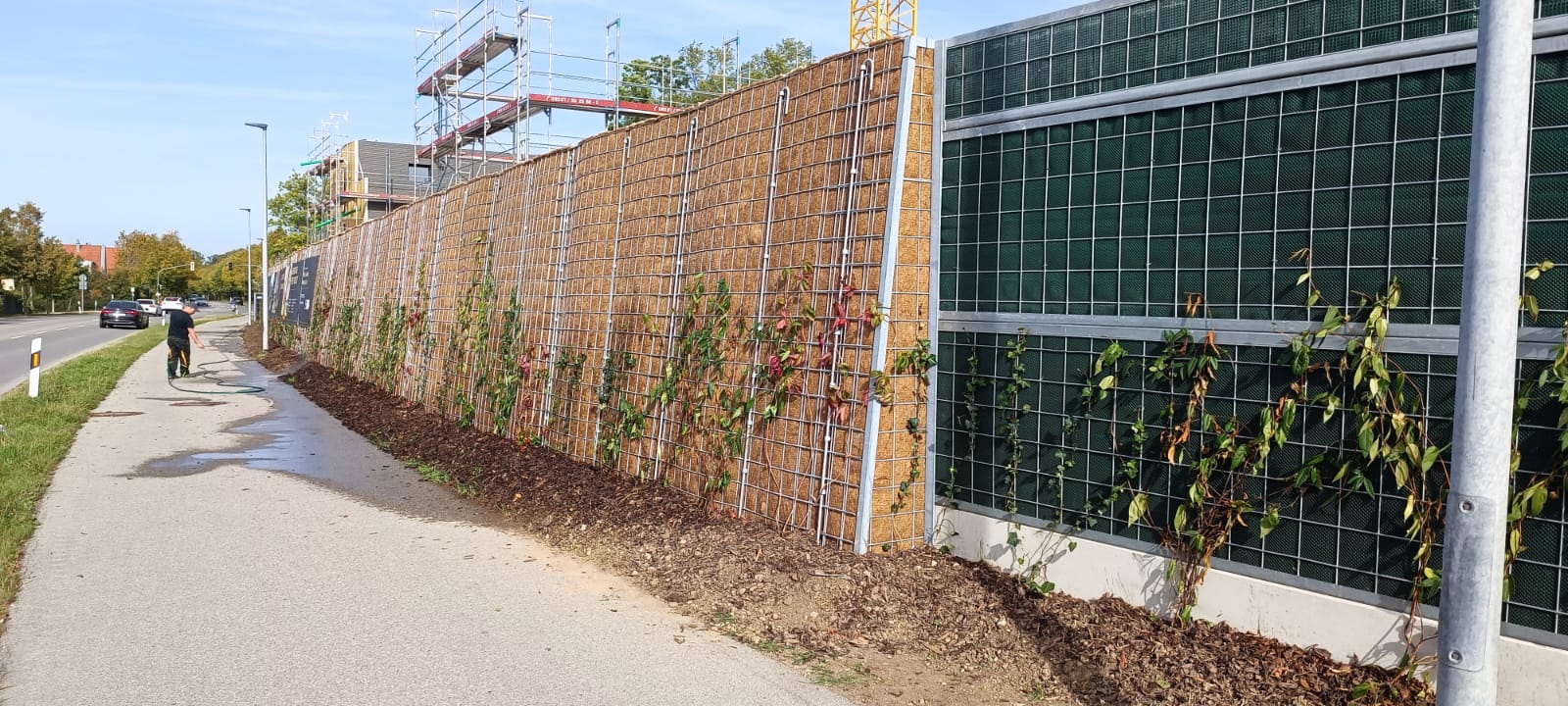
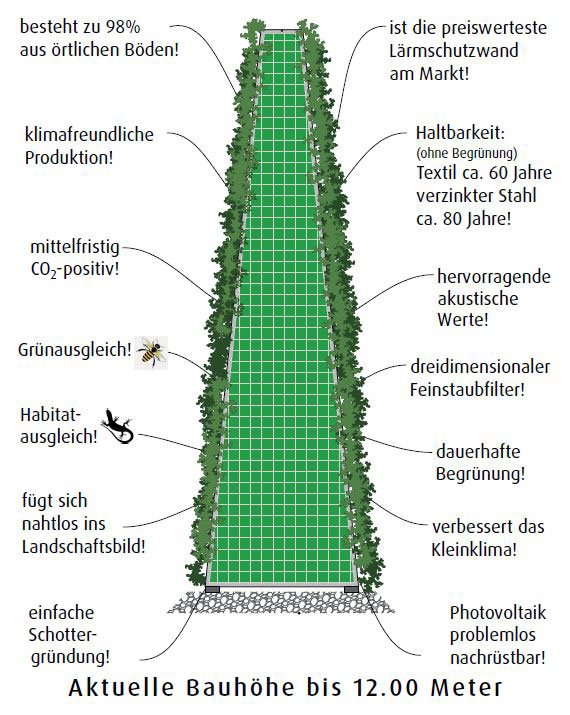
Salzburg is a city with two faces. There is the UNESCO World Heritage Old Town with its fortress, Mozart House, Getreidegasse and the weeks dominated by the festival summer, when the city is bursting at the seams. And then there is Salzburg’s traffic reality: the A1 Westautobahn ends here, the A10 Tauernautobahn begins, and Salzburg Central Station is one of the most important hubs between Central Europe and the southern Alpine region. Those who live in Liefering, Schallmoos or Aigen are familiar with the burden of heavy traffic; those who live in the suburbs on the banks of the Salzach often have to deal with inner-city traffic jams, rail traffic and seasonal peaks. At RAU.bayern, we supply noise barriers from the Allgäu to Salzburg – to private developers, residential developers, commercial enterprises, hotels and municipal clients. Our focus is on green noise protection systems that combine acoustic effect with ecological and design added value. Particularly in a city where the visual appearance of structural interventions is highly regarded, green walls are often the solution that convinces approval authorities, residents and building owners alike. We advise you personally on site and develop a proposal that suits the specific situation.
Noise protection at the highway interface Salzburg - junction of two main axes
Salzburg is the point where the A1 Westautobahn from Vienna and Linz meets the A10 Tauernautobahn heading south. Through heavy traffic heading towards Slovenia, Italy and the south of Austria is concentrated here. In addition, there is domestic and cross-border rail traffic via Salzburg Central Station and Salzburg Airport to the west of the city. At peak times – vacations, summer festivals, weekends in winter with ski traffic – the acoustic pollution is noticeable in the nearby residential areas.
The noise situation varies greatly depending on the district. In Liefering and Itzling, in direct proximity to the highway, traffic noise from the A1 dominates. In the Aigen, Parsch and Gnigl areas, a mixture of city traffic, rail traffic and occasional aircraft noise is typical. In Wals and Siezenheim on the outskirts of the city, there is often commercial and incoming commuter traffic. In the high-priced residential areas on Mönchsberg and Kapuzinerberg, paradoxically, it is often the inner-city traffic noise that impairs the quality of living because the topography traps the sound.
Our RAU systems adapt to these different noise profiles. For residential locations close to freeways, we recommend absorbent walls between 3.5 and 5 meters high, with appropriate structural analysis. For inner-city locations, two to three meters are often sufficient if the wall is strategically located close to the noise source. For commercial applications – such as protecting residential buildings from neighboring businesses – we plan specifically.
Added to this is the rail traffic at Salzburg Central Station, which is a separate noise issue for residents in Schallmoos and along the rail axis – with night-time freight traffic and shunting operations. We examine the situation on site, talk to you about the sources of noise, the peak periods of exposure and the desired level of protection. Only then do we discuss heights, materials and specific costs – not the other way around.
Journey to Salzburg - the short direct route from the Allgäu
It is around 200 kilometers from Kaufbeuren to Salzburg. The route takes you north on the A7, then the A8 towards Munich and straight on to the Salzburg junction. This usually takes two to two and a half hours by truck. This makes Salzburg the easiest Austrian city for us to reach after Innsbruck and Dornbirn – we can deliver on a daily basis, in some cases even on call with a short lead time.
In Salzburg, the A1 junctions Salzburg-Nord, Salzburg-Mitte and Salzburg-Süd are the most important access points to the city. For deliveries to the south, for example towards Anif or Hallein, we use the A10 Tauernautobahn. We usually have good access to inner-city addresses with articulated trucks; only in the narrow streets around the old town and on Mönchsberg do we work with smaller vehicles, with reloading or with deliveries outside peak traffic times. During the festival summer, we deliberately plan deliveries outside peak times because the city is then additionally congested.
For installation, we have experienced partner companies in Salzburg and the surrounding area who are familiar with the local building regulations, the requirements of Salzburg’s World Heritage status and the climatic and topographical conditions. For smaller projects, we bring our own fitters from the Allgäu region – this is often even possible on the same day due to the short journey time. For larger orders, we coordinate with local construction companies. You always have a contact person at RAU.bayern who knows the system and supervises the project from start to finish. The short distance between our location and Salzburg in particular ensures that you don’t have to wait long if you need service.


