
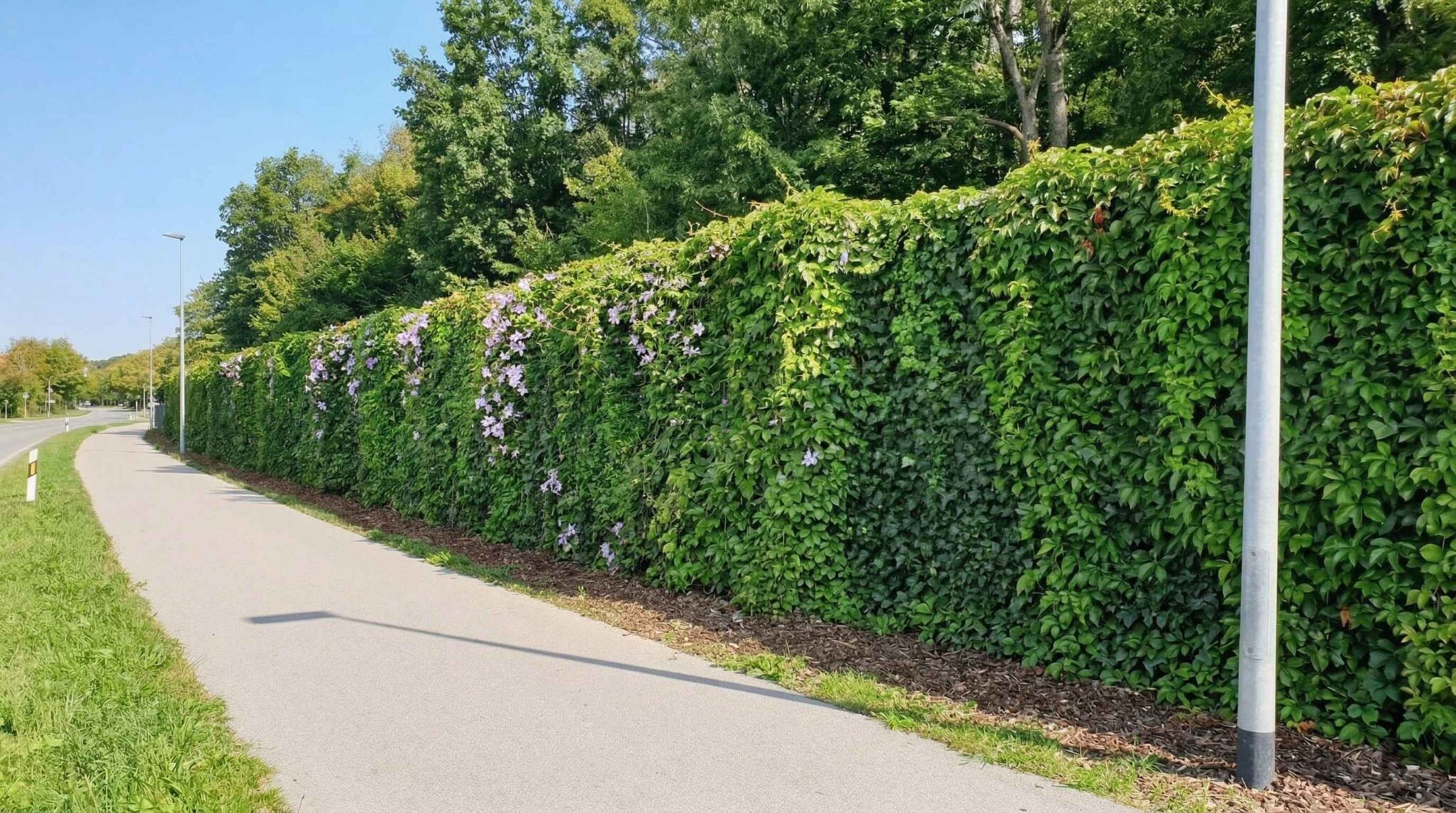
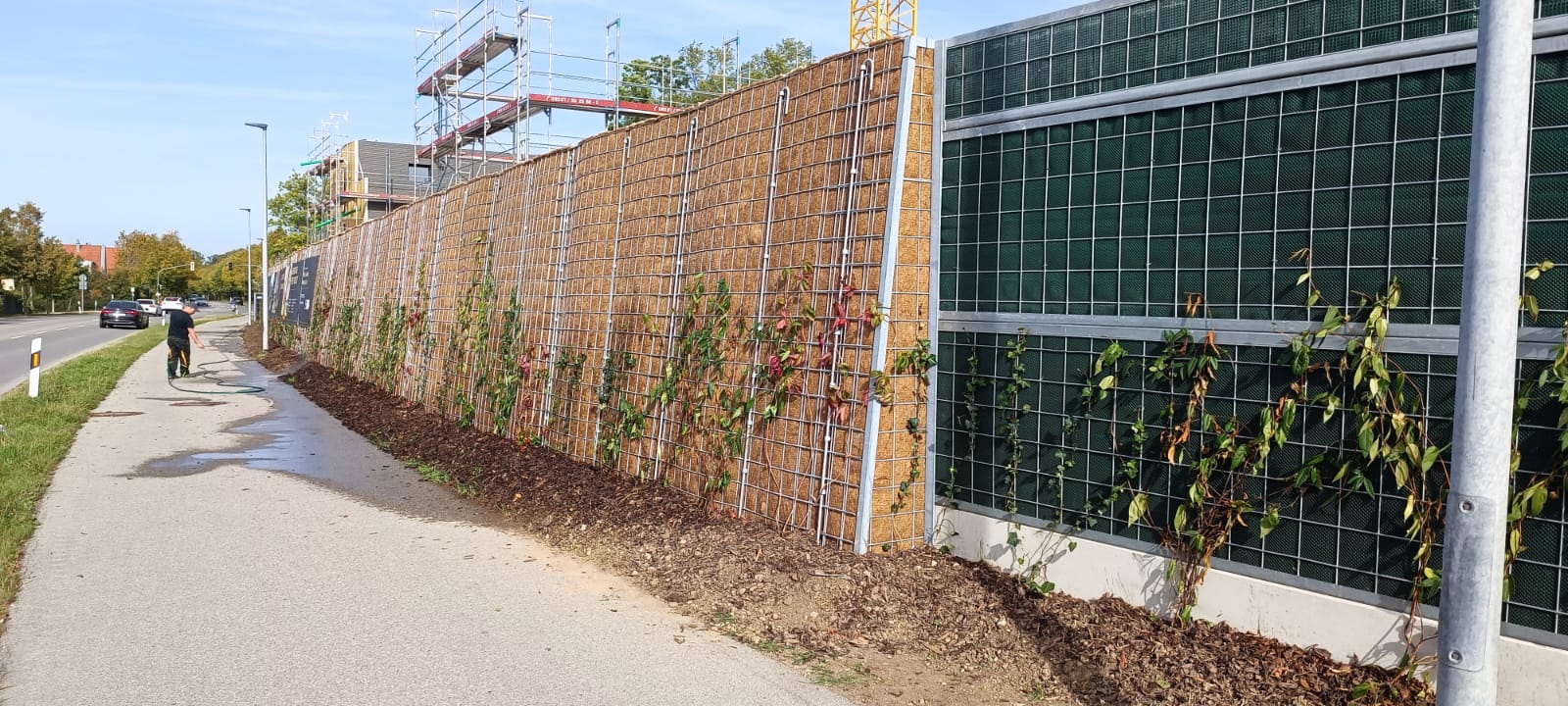
Dornbirn is the economic heart of Vorarlberg – with the Inatura, the Dornbirn Trade Fair, a tradition from the textile industry and a location in the Rhine Valley that allows short distances in all directions. The A14 Rheintalautobahn highway runs past the city to the west and is Vorarlberg’s main traffic axis towards Lake Constance and Switzerland. Those who live in Hatlerdorf, Schoren or Haselstauden are familiar with the traffic noise of this axis; those who live in the city center or on the edge of the wooded hills to the east often have to deal with city traffic and commuter flows. The textile industry tradition – names such as Rüsch, Hämmerle or F.M. Hämmerle – has also left traces in Dornbirn, some of which have now been converted and live on in new neighborhoods. At RAU.bayern, we supply noise barriers from the Allgäu region to Dornbirn and the surrounding areas of Vorarlberg – to private developers, commercial enterprises, residential developers and municipal clients. Our focus is on green noise protection systems that combine an acoustic effect with ecological added value. Especially in a region where architectural and design quality are traditionally highly valued, green walls are often the solution that convinces building owners, residents and authorities.
Noise protection in the Vorarlberg Rhine Valley - traffic, business and housing in a confined space
The Vorarlberg Rhine Valley is one of the most densely populated regions in Austria outside the Vienna Basin. Housing, business, industry and transportation axes are concentrated in a small area. The A14 is Vorarlberg’s main artery, supplemented by the L190 Vorarlberger Straße and a dense network of district roads. There is also rail traffic on the ÖBB Bregenz-Bludenz line, which crosses several Vorarlberg towns.
For noise protection projects in Dornbirn, this means that the location plays a major role in determining the required wall height and type of construction. In Schoren or in the west of the city, in the immediate vicinity of the A14, we are often talking about wall heights of between 3.5 and 5 meters. For inner-city residential areas along the main thoroughfares, two to three meters is usually sufficient. In the suburbs towards Lustenau or Hohenems, there are mixed residential, commercial and traffic situations that require individual planning.
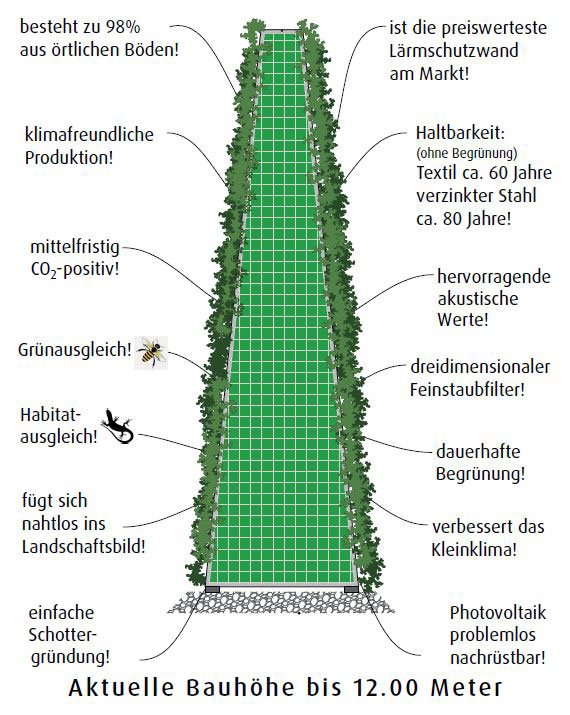
Our RAU systems are absorbent – they absorb sound instead of reflecting it. This is particularly relevant in the densely built-up Rhine Valley, because reflective walls can unintentionally transmit sound to neighboring buildings. In the case of upstream commercial properties – for example along the industrial areas in Dornbirn-Wallenmahd or in the area of the Dornbirn trade fair – there are often additional requirements from commercial noise protection practice.
The situation is often more complex for residential locations at higher altitudes at the foot of the Vorarlberg mountains: noise from the valley is filtered by the topography, but is amplified in some places. Low but strategically positioned walls in combination with landscaped greenery often help here. We discuss the options with you openly and only propose a specific solution after an on-site inspection.
Getting to Dornbirn - the direct Allgäu-Rhine Valley connection
It is around 130 kilometers from Kaufbeuren to Dornbirn. The route leads south via the A7, the A96 towards Lindau and from there the A14 Rheintalautobahn to Vorarlberg in Austria. This is usually an hour and a half’s drive by truck – making Dornbirn the closest medium-sized Austrian town to us. Deliveries can be planned on a daily basis, sometimes even with a short lead time.
In Dornbirn itself, the A14 junctions Dornbirn-Nord, Dornbirn-Süd and Dornbirn-Wallenmahd are the most important access points to the urban area. We usually reach inner-city addresses with articulated trucks without any problems, only in the narrow streets around the market square or in the older residential areas do we work with smaller vehicles. During trade fairs, such as the ARO or other major events at Messe Dornbirn, we coordinate delivery times so that no conflicts arise.
For installation, we work in Vorarlberg with experienced partner companies who know the region – with the Vorarlberg building regulations, with the local climatic conditions and with the high-quality building tradition that is also visible in the craftsmanship in Vorarlberg. For smaller private projects, we bring our own fitters from the Allgäu – the short journey often allows us to do this on the same day. For larger projects, for example along the A14 or for commercial properties in industrial areas, we coordinate with local construction companies. You always have a contact person at RAU.bayern who knows the system and supervises the project from start to finish. The proximity between Kaufbeuren and Dornbirn is a practical advantage that pays off equally when it comes to deliveries, installation and subsequent service requirements.


