
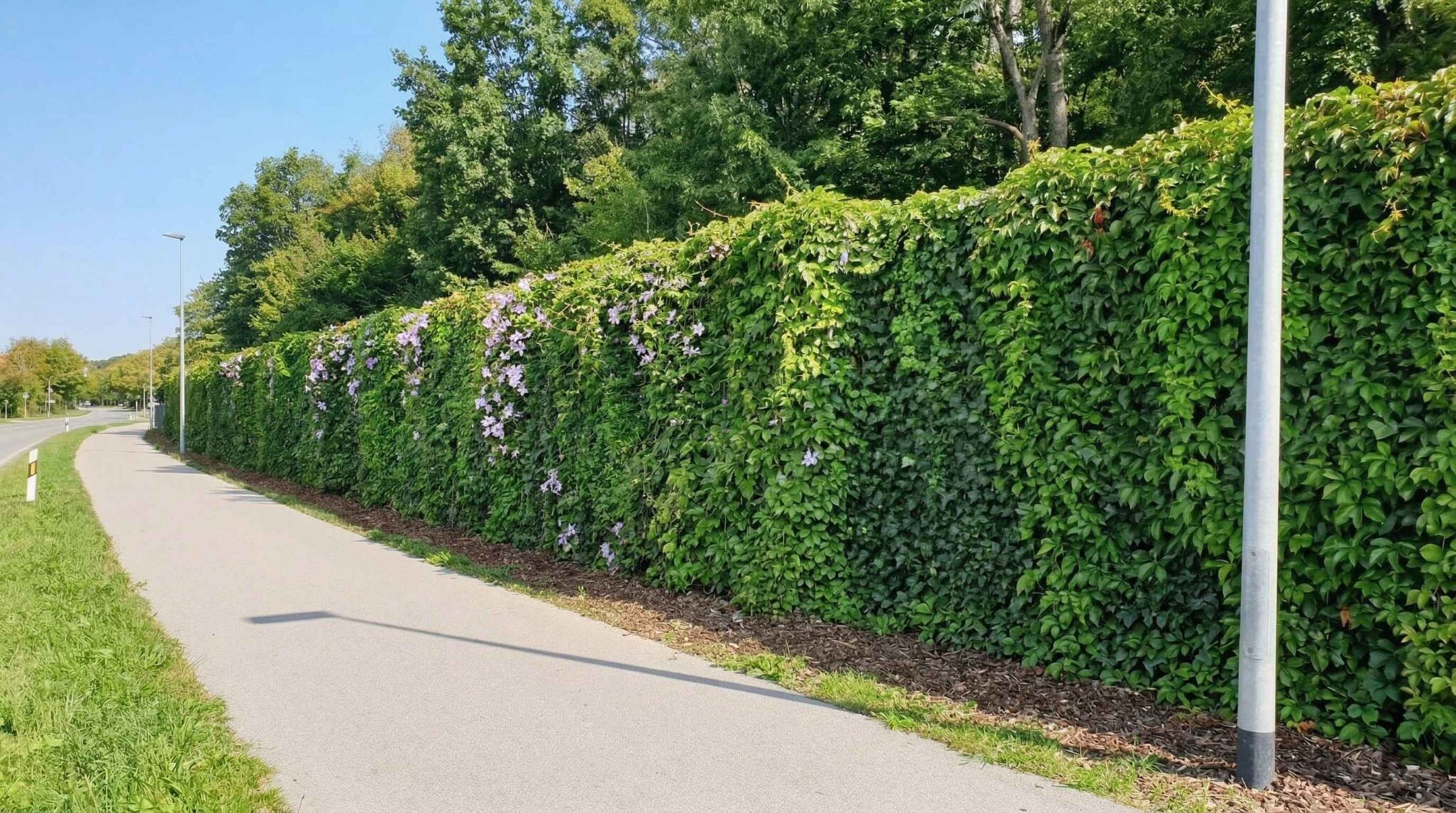
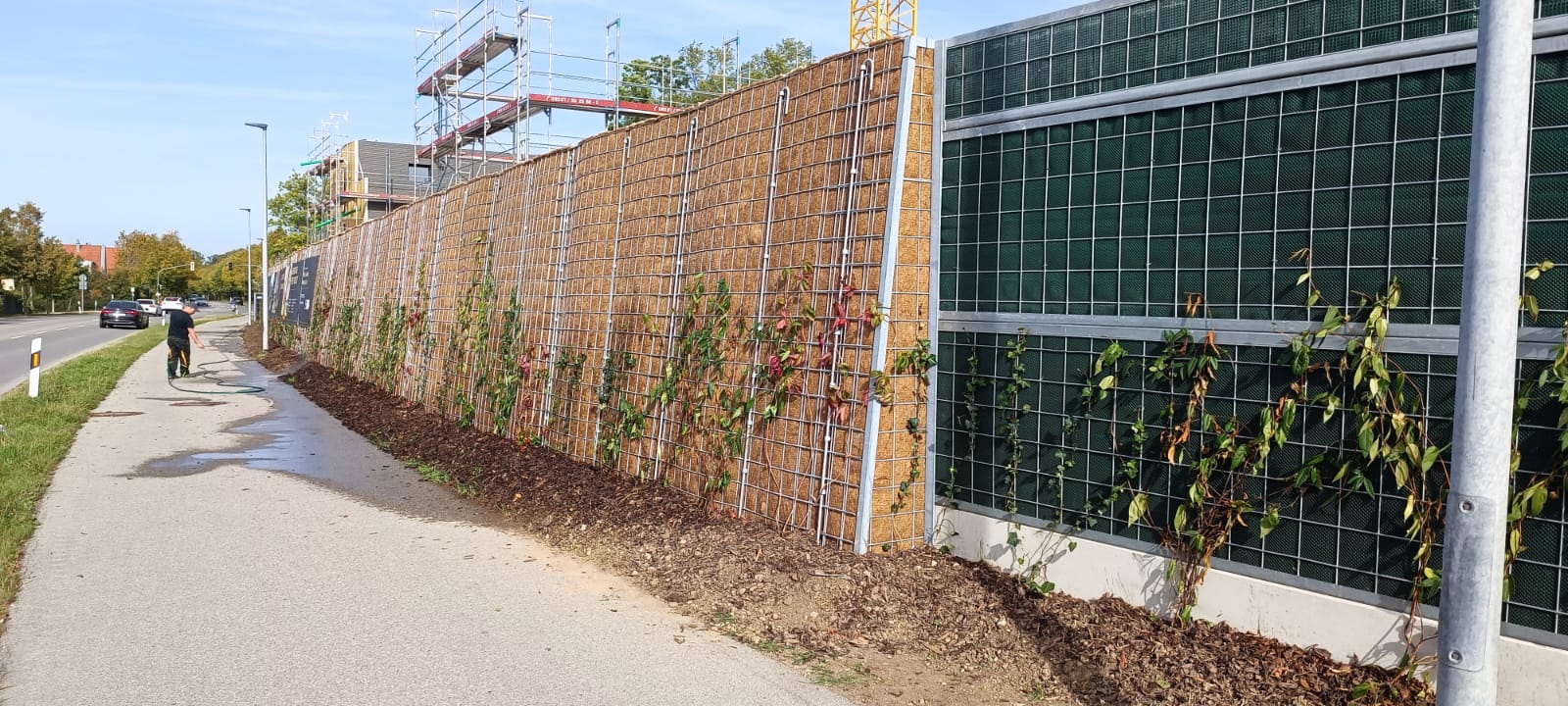
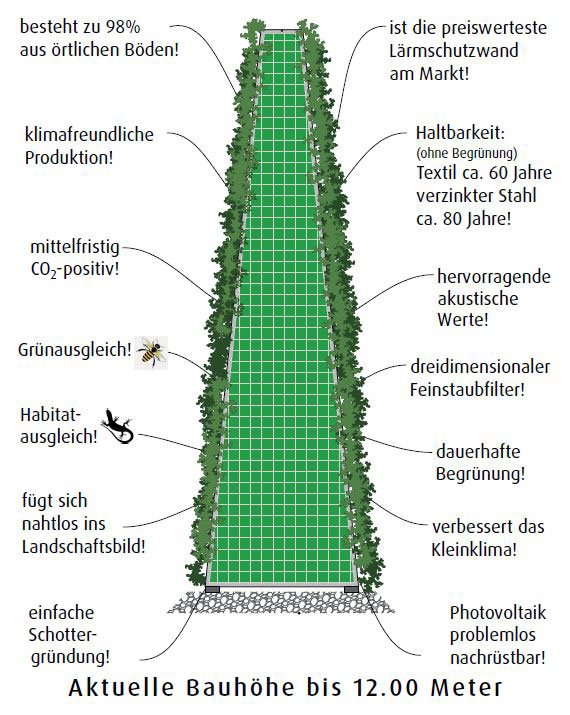
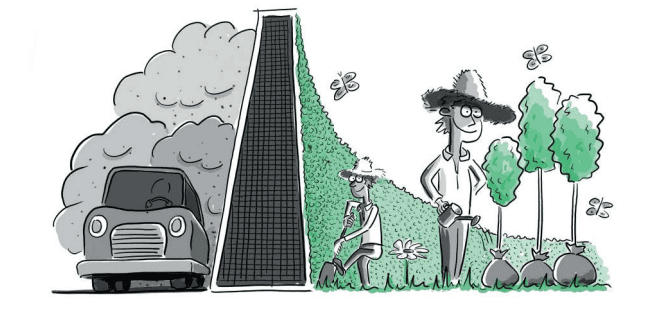
Wels is a city of junctions. Messe Wels is one of the most important event venues in Austria, Wels main station is a central transfer hub between the Westbahn and Pyhrnbahn, and with the A8 Innkreisautobahn and the A25 Welser Autobahn, two main traffic arteries run directly through the city area. Anyone who lives in Pernau, Lichtenegg or Vogelweide knows that Wels is not only a busy district town, but also a city with a high level of noise pollution. Added to this is the continuous heavy traffic heading towards Linz, Salzburg and Steyr, which crosses the Welser Heide, as well as commuter traffic from the Hausruckviertel and Innviertel regions. We at RAU.bayern supply noise barriers from the Allgäu to Wels – to private developers, commercial enterprises and municipalities in the surrounding area. Our focus is on green noise protection systems because, in addition to their acoustic function, they also make an ecological contribution: they bind dust, reduce the summer heat and create vegetation where there would otherwise be none. We advise you personally on site, examine your situation and develop a concrete, verifiable proposal – without empty phrases and without standard offers. In our experience, it is precisely this effort that pays off, because the noise situation in Wels can hardly be solved with standard F-answers.
Noise protection at traffic junctions in Wels - a complex issue
Wels is acoustically complex. Unlike in a purely residential city or a purely industrial city, the sources of noise in Wels are spread across the entire city area. In the south it is the A25 and the connections to the A8, in the north the western railway line, in the center the inner-city traffic around the Wels city center, and in the area of the Wels trade fair there are additional crowds at event times. The Welser Heide as a local recreation and traffic area also contributes to the acoustic pollution.
For an effective noise barrier, this means that it is worth identifying the dominant source of noise on site. Is your property closer to the A25 or the railroad? Does the main noise come during the day or around the clock? Are traffic peaks at peak times the decisive factor or freight traffic at night? The answers to these questions determine the height, location and choice of material for the wall. The question of whether you want to protect your living space, garden or terrace also has an impact on the concept.
For residential areas in Wels, we generally recommend absorbent noise barriers, i.e. systems that absorb sound instead of reflecting it back. This is important because many streets in Wels are built on two sides; a reflective wall on one side could increase the noise level on the opposite side. At heights of between 2.5 and 4 meters, a significant reduction in noise levels can be achieved for most residential locations in Wels, especially if the wall is close to the source of the noise and not right next to the house.
We roughly calculate the effect for you in advance so that you can make an informed decision – and not be surprised afterwards. Anyone building or renovating in Wels should know in advance what the wall will and won’t achieve.
Journey to Wels and logistical handling
It is around 330 kilometers from Kaufbeuren to Wels. The route takes you north on the A7, then the A8 towards Munich and Salzburg, then on the A1 Westautobahn to the Wels exit. The journey takes around three to three and a half hours, making Wels one of the easiest Austrian cities for us to reach logistically. Deliveries can be planned on a daily basis and we can often react more quickly to short-term requirements than for more distant locations.
In Wels itself, the Wels-West and Wels-Ost exits on the A25 and the A8 Sattledt junction are the most important access points for our trucks. Inner-city construction sites – for example in the Pernauer Straße area or around the Wels Volksgarten – are usually reached without any problems. In densely built-up residential areas, we work with smaller vehicles if necessary and coordinate delivery times so that residents are not unnecessarily inconvenienced. For inner-city addresses with pedestrian zones or residential streets, we also schedule early deliveries to avoid peak times.
When it comes to installation, simple wall systems along a private garden can often be erected in a single day. For longer protective structures – such as along commercial properties on the Welser Heide or multi-party houses near a train station – we plan several working days and work with experienced partner companies from the central Upper Austrian region. For you, this means that you have a contact person from our company who knows the system and a company on site that can react quickly. We have opted for this mixture of manufacturer responsibility and regional implementation because it has proven to be the most resilient constellation in practice.


